Intelligent Without Obedience
I have always loved birds, though not in the way people usually mean when they say that.
My mother-in-law loves birds, like a normal person. She birdwatches. She knows the birds of her region by name, season, and pattern. Her attention is patient, and she placed field guides into my children’s hands before they could even read.
My relationship with birds, however, is less intellectual and more … wishing I were Snow White.
Birds attach themselves to moments for me. They invade my memory the way certain songs or smells do. But in addition to their presence, I am drawn to their behavior.
One of my earliest tattoos was of a peacock. My oldest son was obsessed with them when we lived in Hawaii, where they seemed to freely roam many places. The appeal was simple. Peacocks carry their beauty openly, without softening it for anyone. Nothing about them asks permission to exist in the space they occupy. In a way, the tattoo felt like permission to align with that freedom.
I have considered another bird for permanence on my body. The turquoise-browed motmot. Now that is a rare beauty. He looks to have been colored in by Lisa Frank, and his glorious tale attached haphazardly by a toddler with a glue stick. It is the national bird of Nicaragua, a place where I have spent several sessions in mission work. Nicaragua is a place that teaches endurance quickly. Life there asks more of people than comfort ever would. Yet in that landscape of little, the motmot thrives. A small stunning detail placed into the world by God.

For a number of years we not only raised chickens, but also kept birds in our home. A sun conure, parakeets, and these two karaoke loving cockatiels. They often lived freely through the house, and visitors rarely appreciated that arrangement.
The number of grown adults that I witnessed ducking and flinching when a bird no larger than my palm crossed the room overhead ... That reaction always fascinated me. Those same people would laugh when a large dog barreled toward them, or tolerate a cat leaping onto their chest. But a tiny precious bird fluttering through the air seemed to provoke a kind of fear response that I couldn't reconcile.
Birds do move differently through a space. In their natural environments, they arrive suddenly and leave just as quickly. Mammals approach on shared terrain, but birds can cross above it. I think their movement has influenced humans to want more from their abilities, probably for all of time.
My birds would circle the room before settling somewhere high, like a curtain rod, or the top of a cabinet. From there, they watched everything below them with bright, alert attention. It’s hard not to notice how different the room feels when something living occupies the air. Everyone points when a bird somehow makes its way into the Home Depot rafters.
My daughters and I share a particular affection for pigeons, without irony. Pigeons are treated as visual clutter in most cities. “Rats with wings,” I’ve heard. That’s crazy to me. Have you ever watched their feathers shift with soft iridescent greens and purples that reflect light like spring water? Still, they are associated with inconvenience and dirt, a side effect of city life rather than a participant. Something to dodge while eating lunch in public. But pigeons persist. They live where they live. They eat what is available. They eat like kings when my family is near, always one of us blocking the please do not feed the birds sign. I bet you can guess my favorite character in Mary Poppins.
One of my favorite memories with my children happened on a ferry to Ocracoke Island. We brought crackers to feed the seagulls. The birds flew alongside the boat, riding the wind close enough to take food directly from our hands. Their wings stretched wide beside us while the boat moved across open water. Other passengers watched and pointed from a distance. Someone complained out loud that the birds were going to poop on their cars because of our drawing them near. But for us, the experience was electric. A feral creature matching our movement through open space, sharing a small exchange before vanishing back into the sky. Nobody will remember cleaning poop from a windshield, but memories like this embed.

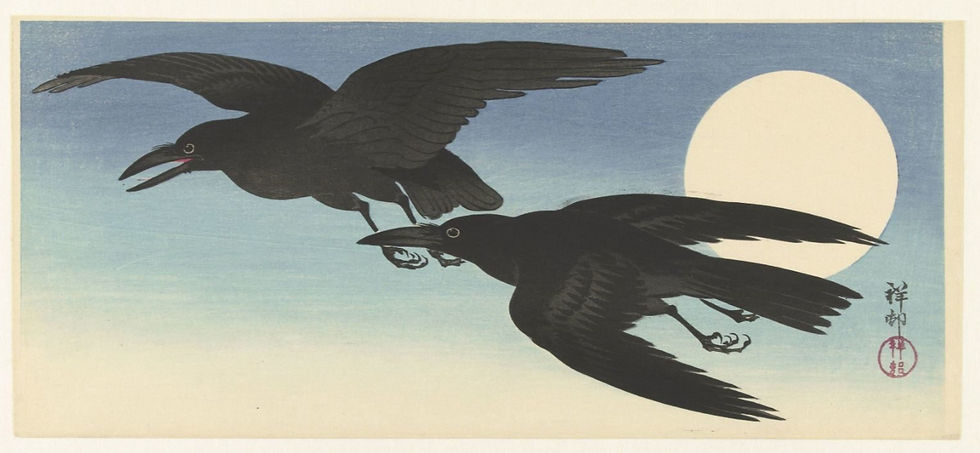
I have come to a conclusion on why I think birds must unsettle people. It can't be because they appear dangerous. I think that people somehow, and perhaps unknowingly, are threatened by the fact that birds are intelligent without being obedient. Speaking of, crows belong firmly in that category.
In Western imagination, crows and/or ravens (I still don’t know the difference) carry centuries of omens and darkness. They are the birds that Poe and Hitchcock use to send shivers down your spine. Culturally, they are now symbols of meaning that has very little to do with the animal itself.
The real bird, however, is observant, social, and exceptionally clever. Did you know they can remember faces, and mimic human voices? They learn systems quickly, and thrive in environments most animals, even other birds, would struggle to navigate.
In Japanese folklore, the Yatagarasu, a three-legged crow, appears as a guide sent to help someone find the correct path. Far from the fear and death symbols we know them as in America. Even outside mythology, crows remain part of the landscape here rather than something entirely pushed away.
Since moving to Japan, of course I have fallen in love with them. The Japanese don’t distinguish between ravens and crows, they call them both karasu. And the karasu here are enormous. Their feathers reflect oil-slick greens and purples so vivid the black nearly disappears.
My daughter beamed with surprised excitement the first time she heard them outside our home when we moved here. She loves to read and watch anime, where the sound of karasu often fills the background of outdoor scenes. “It sounds just like my anime here,” she said. And what once felt like a stylized atmosphere turned out to be her ordinary reality.
We weren’t prepared, however, for those caws to come with even more attention-seeking. They are definitely crafty enough to be more inconvenient than a simple city pigeon ever thought about being. Garbage has to be secured carefully because they will open bags and scatter their contents with remarkable efficiency. I still love that we get to coexist in a way that has unspoken rules between us.
I couldn’t end my pro-bird argument without pointing out that birds also appear in Scripture way more often than people notice.
After the flood, Noah releases a raven from the ark. That one doesn’t get painted in the rainbow murals, does it? The bird disappears into the open sky and does not return. Later, he sends the dove. It comes back once with nothing, and then again carrying an olive leaf in its beak - proof that the world was still capable of supporting life. Of all the heroes in the Bible, the messenger that informed humanity that the earth had begun again was a just a quiet little bird.
Elsewhere in Scripture, the prophet Isaiah describes God protecting Jerusalem like birds hovering overhead. When we lived in the Marshall Islands, the ferry terns would swoop within a couple feet of our heads if we walked near a palm tree that housed their baby. Never mind that the baby was 80 feet above us! So the image Isaiah gives makes perfect sense … constant motion, watchful, and ready. That is our God.
Birds move easily through the pages of the Bible this way. Ravens, doves, sparrows, eagles. Appearing briefly and lifting out of the story again, just as they do in life.
The Bible describes those who wait on the Lord as rising on wings like eagles. That kind of movement, the lift, strength and height, is something humans are used to watching, not experiencing. But the message is physical, and it defies gravity. Of course, our God.
Peacocks, pigeons, motmots, crows, and terns. Each one marks a place or a season in my life. They move through the world above our explanations. They cross boundaries we think are fixed. They are romanticized into symbols or dismissed as pests, but in response they rise, circle, land, and rise again, relatively uninterested in the stories people attach to them.

Whenever I see a bird catch a current of air and rise without effort, for a moment, I notice my arms feel lighter. Flight remains one of the few things in nature that still feels magical. A body lifting itself away from gravity and moving wherever the air will carry it.
Every now and then, watching one lift its chest and ascend cleanly into the safety of air, I find myself wondering.
What it must be like.


